Finding Healing Through Fly Fishing
/By Makani Christensen
October 6, 2026
I recently visited Boise, Idaho, where I met Chris, a fellow veteran and the Pacific Northwest coordinator for Project Healing Waters.
Established in 2005, Project Healing Waters helps veterans cope with emotional and physical wounds through the therapeutic experience of fly fishing. Whether standing in a stream, casting on the flats, or floating in a boat in the middle of the ocean, veterans have an opportunity to remain active, reconnect with nature, and redirect their energy toward something positive.
The organization brings veterans together through shared experiences, creating opportunities for healing, friendship, and understanding. It allows them to step away from the trauma of war and the challenges of everyday life, replacing those burdens, even if only for a moment, with peace, purpose, and happiness.
Chris and I discussed organizing an informal gathering of veterans in the Boise area to talk about fly fishing in Hawaii. We wanted to create a safe and welcoming space where veterans could share their experiences, learn about Hawaiian culture, and discover the healing opportunities that fly fishing can provide.
I also wanted to share my own story and invite fellow fly fishermen to Hawaii. Many of the people I fish with are veterans themselves, and I have seen firsthand how fly fishing helps us cope with the lingering trauma of war.
When Chris brought everyone together, I felt honored to speak to my brothers and sisters in arms.
I made a few wrong turns before finally turning into the parking lot of the VA facility. I arrived early and waited in my truck, using the quiet time to gather my thoughts. I jotted down a few notes and outlined the points I wanted to cover: the introduction, the body, and the conclusion. Once everything was organized, I felt ready.
Soon, more people began arriving. I introduced myself to each person as they entered the parking lot, and together we made our way inside.
What began as an informal meeting quickly became something much more meaningful. Perhaps we would make new friends. Perhaps, when I returned, we would have something to share. Whatever happened, I knew there was a reason for being there.
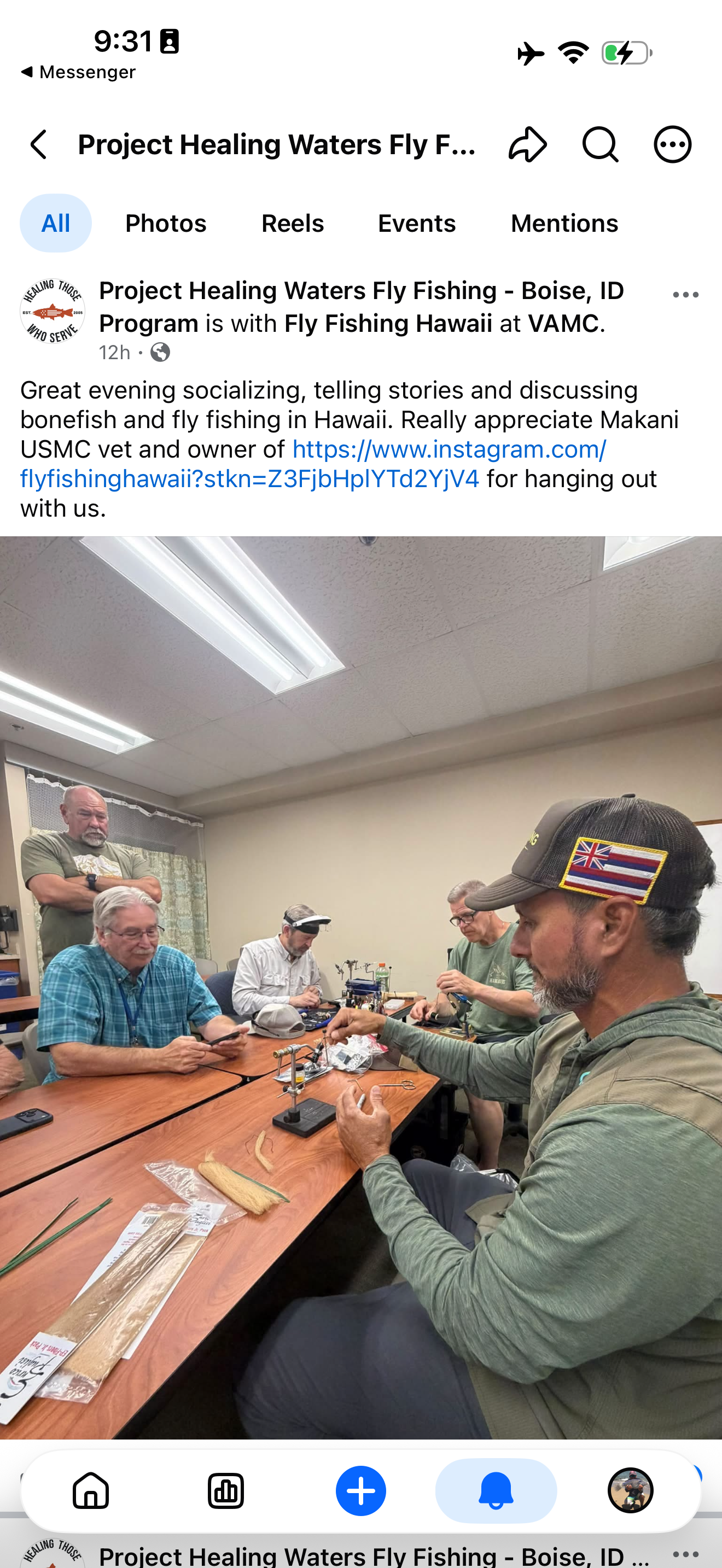
We entered the facility and gathered in a classroom. Approximately thirty chairs were arranged throughout the room, with a podium at the front and a dry-erase board beside it.
The room was well equipped, and everything we needed was there.
Chris introduced me to the group gathered on one side of the room. Looking around, I realized I was probably the youngest veteran there, at forty-six. Another veteran’s daughter appeared to be about my age.
At forty-six, more than twenty years after fighting my war, I wasn’t sure whether anyone could relate to my experiences.
Some of the men were Vietnam veterans. Others had served in Iraq, Afghanistan, or during another conflict. We came from different generations and carried different memories, but we shared similar backgrounds and experiences. Somehow, despite those differences, we found ourselves standing on familiar ground.
It felt safe to say that few of us had escaped the lasting effects of war.
If you fought in combat and returned home, your life was forever changed. If you missed the action, perhaps you were among the fortunate ones who could sleep peacefully at night, without the memories that refuse to fade.
Regardless of our backgrounds, we had all volunteered to serve our country and protect our way of life.
The freedoms we enjoy are not free. Blood has been shed protecting the ideals that govern our great nation.
“We the People” are the opening words of the Constitution, reminding us of the principles we once swore to defend.
As I stood before that group, I had the honor of speaking to men and women who understood the meaning of service, sacrifice, and the responsibilities that come with both.
I knew I needed to read the room and understand my audience.
That part was easy.
The challenge was delivering my message.
Fortunately, I had already structured what I wanted to say, writing down the main points just minutes before the first truck entered the parking lot.
Every good talk begins with an introduction. I wanted to keep mine simple by answering the five W’s: who, what, where, when, and why.
The first four were easy to explain.
The fifth—why—was the reason we had all come together.
Why do we fish?
Why does standing in a river or casting across the ocean bring us peace?
Why do so many veterans find comfort in something as simple as a fly rod, a stretch of water, and the hope of a fish?
I shared examples of how fly fishing has helped us stay sober, choose a different path, and find purpose when life seemed overwhelming.
I spoke about the anger that can consume us, the rage sometimes drowned in alcohol or other substances, both legal and illegal, and the temptation to numb the pain rather than confront it.
For many veterans, these struggles are real.
Yet when you learn to clear your mind and focus on the water, something begins to change. You stop dwelling on your problems and become present. That is where the connection happens.
We shared a common past, and now we fish to heal.
I explained how many of us veterans in Hawaii fly fish together. We share stories, encourage one another, and find strength in the friendships we have built.
I described the opportunities to fish in Hawaii and the importance of introducing fellow veterans to the experience.
I also explained how fly fishing can be different for each of us. Some find peace in the solitude of the water. Others find it in the companionship of friends who understand what they have endured.
I spoke for a while, covering many topics and subtopics related to fly fishing in saltwater. The conversation flowed so naturally that it seemed only minutes had passed.
Then I looked around the room and realized I had been speaking for nearly two hours, answering questions and tying flies.
The audience remained engaged. My fellow veterans asked thoughtful questions, and each answer led to another conversation rooted in personal fishing experiences.
One question stood out:
“Why are the flies so heavy?”
The answer was simple, but it opened the door to a deeper discussion about our unique fishing conditions in Hawaii.
Before I knew it, there was even more to share.
Knowledge is power, and it can make the difference between catching fish and going home without one.
Learning from fellow fly fishermen, sharing experiences, and helping others understand the fundamentals of fishing are all part of becoming successful.
And the learning never ends.
There is always something new to discover.
Sometimes, that discovery begins with something as small as a fishing fly. As you put all the pieces of the puzzle together, you begin to see the bigger picture.
You start hooking fish.
You begin to understand the water.
You gain confidence in your abilities.
Somewhere along the way, without even realizing it, you may begin to heal.
That is what we shared that day.
Be curious.
Be willing to listen.
Be excited to learn something you have never done before.
Sometimes, the greatest lessons in life come from the simplest experiences. A fly rod does not erase the past, and the water does not ask us to forget it. Instead, it gives us a place to carry what we have lived through without carrying it alone.
Among veterans, a cast can become an invitation. One person teaches another. A story is shared. A quiet moment becomes a reminder that service may have ended, but the bond between those who served can continue.
Then the line lifts from the surface, the rod bends, and the water opens in front of us. For that moment, there is no need to explain where we have been or what we have lost. We stand together, watching the current and ready for whatever comes next.