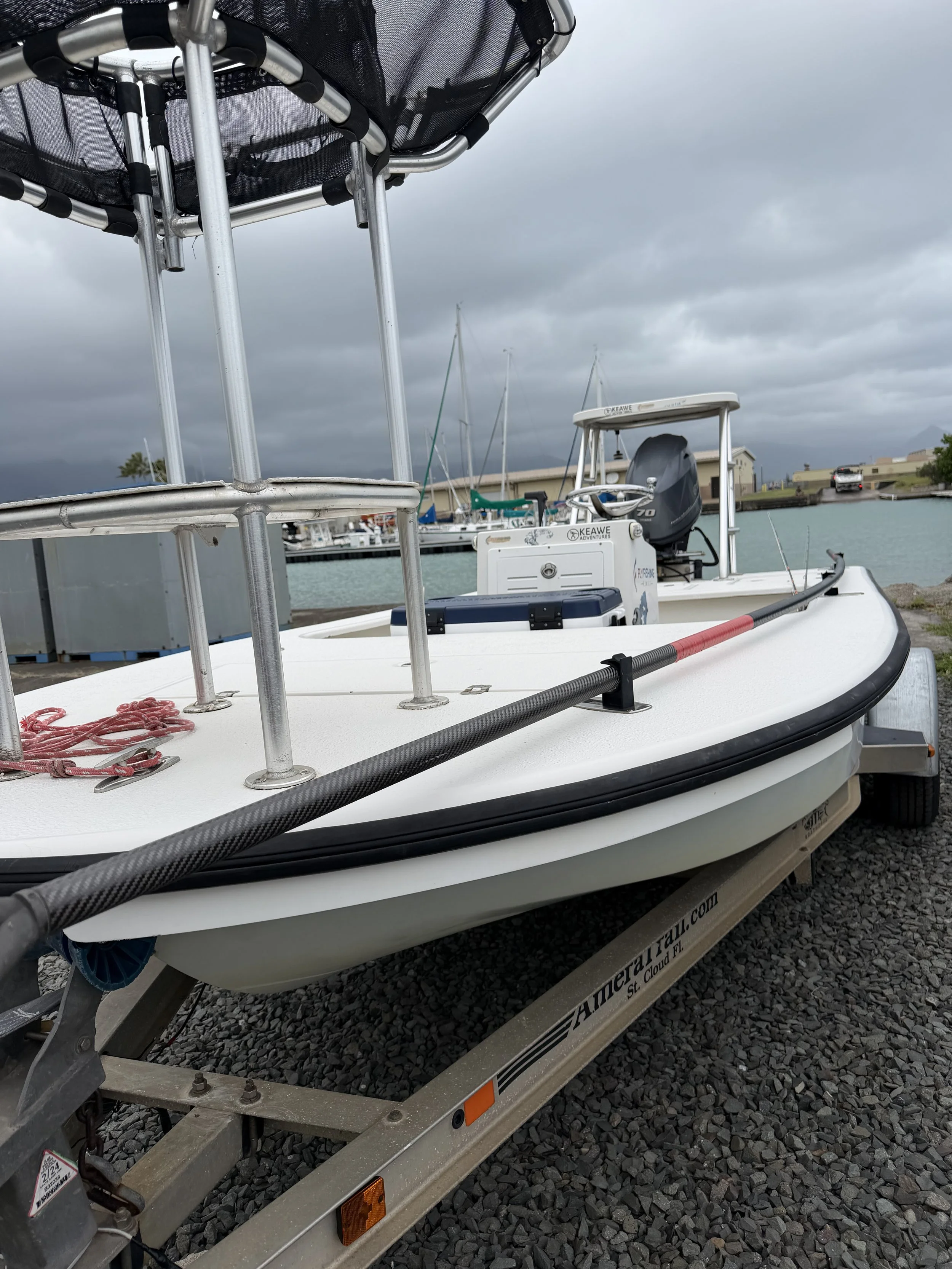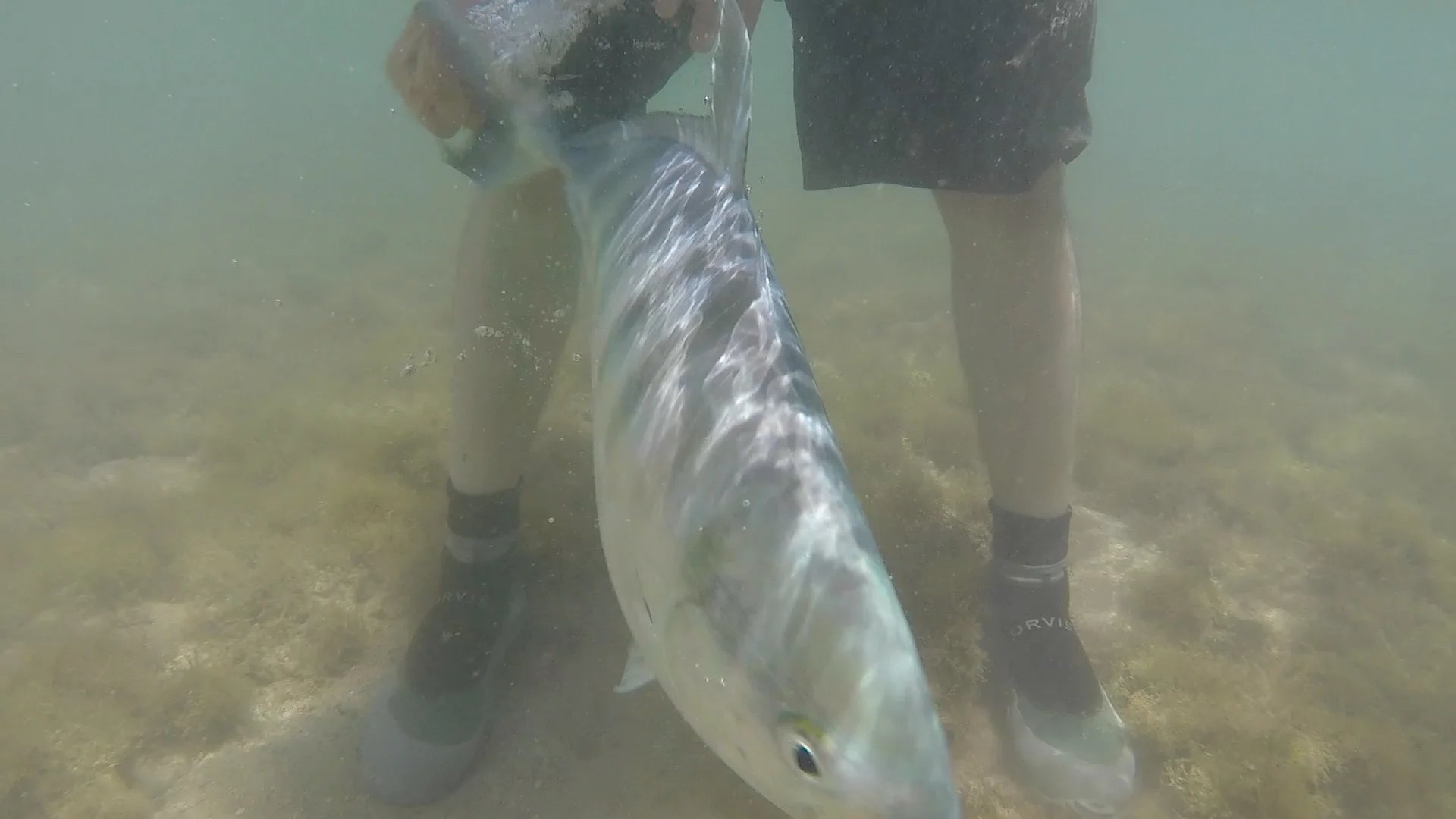
Fishing from a Flats Boat
/By Makani Christensen
Fishing from a flats boat offers several advantages, particularly when sight-fishing for bonefish in Hawaii. However, it also presents challenges that require experience, patience, and an understanding of how wind, tides, sunlight, and boat positioning affect the fish.
One of the greatest advantages of fishing from a flats boat is the elevated line of sight. Standing higher above the water allows anglers to see fish at greater distances. The higher your vantage point, the farther you can see into the water, making it easier to locate fish before they come within casting range.
Another advantage is the ability to approach fish quietly. From a raised platform at the rear of the boat, a guide can often see into the water more clearly while using a push pole to maneuver across the flats. Poling allows the boat to approach fish without disturbing the bottom or creating unnecessary noise that might spook them.
Despite these advantages, fishing from a flats boat in Hawaii comes with its own set of challenges.
The Challenges of Wind
Hawaii is known for its strong trade winds, which frequently blow between 20 and 30 miles per hour. Under these conditions, controlling a flats boat from the poling platform can become extremely difficult.
Once you enter the flats, the wind often determines where you can go and how quickly you move. Traveling too fast reduces the amount of time an angler has to identify a fish, prepare a cast, and make an accurate presentation.
Wind direction also plays an important role. If a fish is positioned to the left or right of the boat’s path, the guide must consider how the wind will affect the angler’s ability to cast. A strong headwind or crosswind can make an otherwise manageable presentation extremely difficult.
Slowing the boat gives the angler more time to react, but doing so in strong winds requires considerable skill. Every time the push pole contacts the bottom, it can create noise or vibrations that may alert nearby fish.
Traveling at excessive speed presents another problem. The angler must be capable of casting in different directions, often with very little warning. This is not easy, particularly when the wind is constantly changing the boat’s position.
On calm days, however, the situation is entirely different.
Fishing in Calm Conditions
When the wind is calm, a flats boat can be maneuvered across nearly any suitable area, provided there is enough water to navigate safely.
Under these conditions, sunlight becomes an important tool for locating fish. Keeping the sun behind you improves visibility into the water by reducing glare. Bonefish generally do not look upward toward the sun, so positioning the boat with the sun at your back can also make your approach less conspicuous.
Calm conditions allow the guide to move slowly and deliberately, providing the angler with more time to identify fish and prepare a presentation.
In many ways, calm weather creates ideal conditions for fishing from a flats boat. Unfortunately, those conditions are not always available in Hawaii.
Controlling the Drift
Coach Duff, a pioneer of flats fishing in Hawaii, developed a method for slowing a flats boat in strong winds.
He used a small, custom-made parachute designed specifically for flats boats. This device, commonly known as a sea anchor or drift chute, creates resistance in the water and reduces the boat’s drifting speed.
By slowing the boat’s forward movement, the sea anchor gives anglers additional time to spot fish, prepare their casts, and make accurate presentations.
Rather than allowing the wind to push the boat uncontrollably across the flats, the sea anchor creates a more manageable drift.
When the wind becomes too strong for the chute to provide sufficient control, another method is necessary.
If the tide is high enough to allow it, I will sometimes deploy an anchor from the rear of the boat and wait for fish to cross our path.
Although this eliminates the ability to cover large areas of water, it provides a stationary platform from which anglers can observe and cast to approaching fish.
Drifting across the flats is not always an option. Sometimes, remaining in one location is the better strategy.
The Advantages and Disadvantages of Anchoring
Anchoring a flats boat can give anglers additional time to prepare their casts. When the boat is stationary, there is no need to compensate for its forward movement, allowing the angler to concentrate on the fish.
However, anchoring introduces another challenge.
Once the anchor is deployed and the boat comes to a stop, waves begin striking the hull. Depending on how the fish are feeding and the surrounding conditions, the noise may be enough to discourage fish from approaching.
In shallow water, even relatively small waves can create noticeable noise against the bottom and sides of a boat.
For this reason, anchoring is not always the best solution. A guide must evaluate the conditions and determine whether the benefit of remaining stationary outweighs the possibility of disturbing nearby fish.
Understanding Fish Behavior
Sometimes, bonefish behave in ways that are difficult to explain.
I have encountered situations where fish appear to be looking upward for no obvious reason. When this happens, we may change our fishing location entirely.
At other times, fish can be seen from considerable distances, but reaching them with a fly becomes a challenge.
If a fish is spotted far from the boat, the angler may need to make a much longer cast than usual. This becomes particularly difficult when strong winds, poor lighting, or an unfavorable casting angle are involved.
The ability to recognize these situations and make the necessary adjustments is an important part of successful flats fishing.
Visibility and the Importance of Presentation
One of the disadvantages of fishing from an elevated position is that visibility works both ways.
Just as an angler can see bonefish from farther away, bonefish may also detect the angler and the movement of the fly rod from a greater distance.
Even the smallest movement can affect how a fish reacts.
Keeping the rod smooth and, whenever possible, positioned to the side can make a significant difference. Sudden or exaggerated movements are more likely to attract the fish’s attention.
Bonefish are particularly sensitive to movement. Their initial response to an unfamiliar or threatening movement is often to flee.
For this reason, I frequently adjust an angler’s casting position, encouraging a sidearm cast that keeps the rod as low as possible when fishing from a boat.
The goal is to minimize unnecessary movement while delivering the fly accurately and quietly.
There are times when bonefish can detect a boat from an extraordinary distance. I have personally watched fish spook from more than 50 yards away, even when the boat appeared to be moving quietly.
The angler’s position, the depth of the water, and the direction of the sun all influence how visible the boat and its occupants are to the fish.
These factors must be considered before making an approach.
Choosing the Right Approach
Not every angler is a proficient caster, and not everyone has experience fishing from a flats boat.
As a guide, I must consider each client’s experience, casting ability, and comfort level before deciding how to approach the fish.
Different anglers require different techniques.
For an experienced angler who can make accurate casts at a distance, I may use a sea anchor to slow the boat while allowing us to cover more water.
For an angler who needs additional time to prepare and cast, I may choose to anchor the boat and wait for fish to approach.
On calm days, I often rely on the push pole to navigate the flats quietly and position the boat for the best possible presentation.
Each adjustment serves the same purpose: to increase the angler’s chances of spotting fish, making an accurate cast, and ultimately catching one.
Final Thoughts
Fishing from a flats boat in Hawaii is about much more than standing on an elevated platform and looking for bonefish.
It requires an understanding of wind, tides, sunlight, water depth, fish behavior, and the limitations of both the boat and the angler.
A successful guide must constantly evaluate these conditions and make adjustments throughout the day.
Sometimes that means covering water with a push pole. Other times it means slowing the drift with a sea anchor or remaining stationary and allowing fish to come within casting range.
There is no single approach that works in every situation.
The key is knowing when to move, when to slow down, and when to remain still.
Ultimately, the decisions made before the cast are often just as important as the cast itself.