
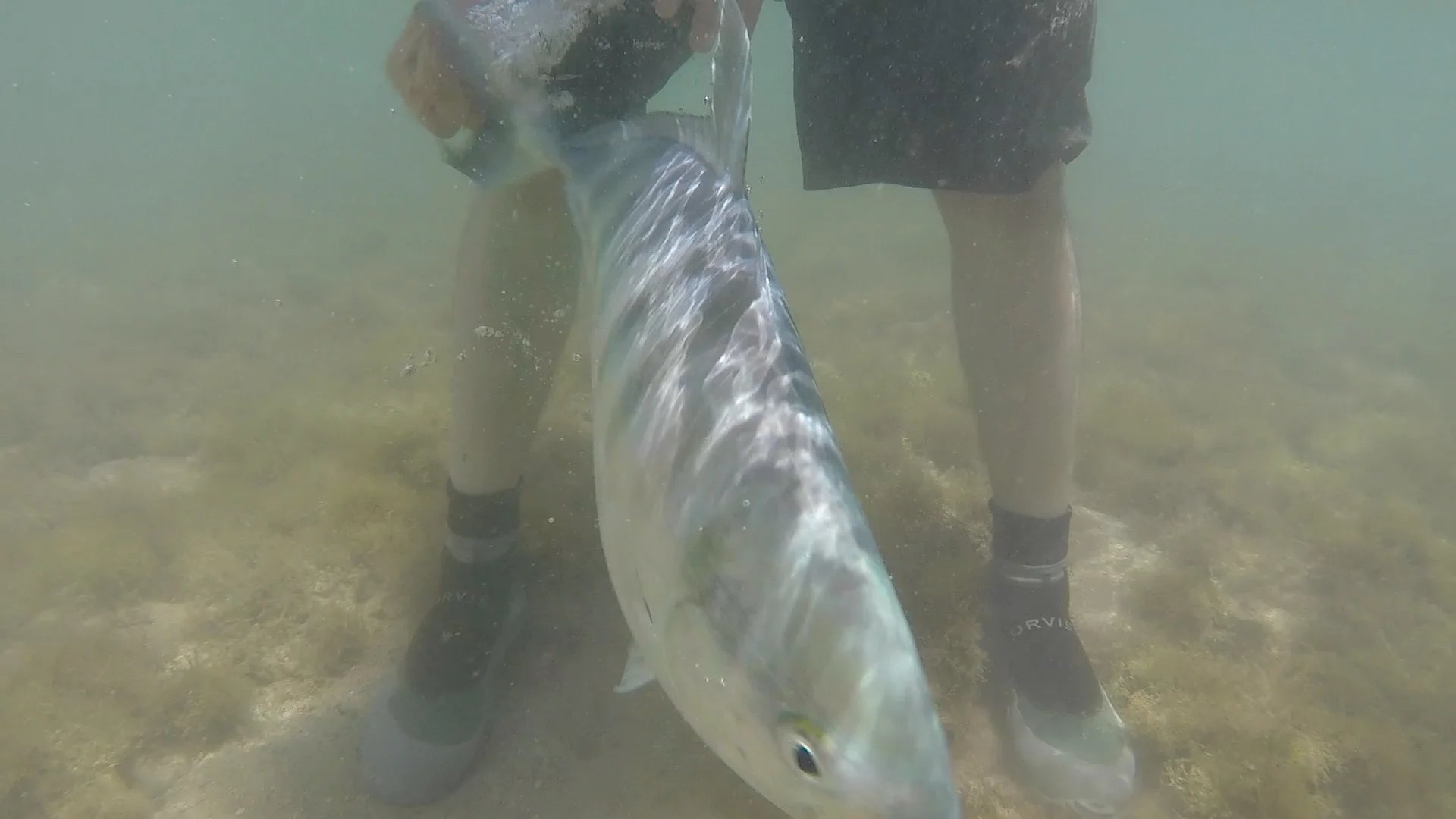
Double Digit Bonefish
/By Makani Christensen
October 31, 2026
Each year, we keep track of how many double-digit bonefish we catch. On average, we land maybe two per year. Catching a double-digit bonefish is just as rare as catching a golden trevally.
One reason is that we generally try to catch the first bonefish we see. Remember, catching bonefish is already difficult enough, so we’re not always actively targeting the biggest ones.
It also depends on where we’re fishing. On the flats, you’ll sometimes find large bonefish swimming alone, in pairs, or mixed among schools of smaller fish.
Here in Hawaii, our average bonefish weighs somewhere between four and seven pounds. There’s a noticeable difference between a seven-pound bonefish and an eight-pounder. In fact, when you catch an eight-pound bonefish, it can look like an eleven-pounder!
If you’re not accustomed to catching large bonefish, you might easily mistake a seven- or eight-pound fish for a ten-pounder. Without a scale, accurately estimating the weight of these fish can be difficult.
I’ve experimented with using artificial intelligence (AI) to estimate fish weights from photographs. Although I’ve occasionally been able to verify its predictions, the results vary considerably. Without a reliable reference for scale, AI can easily misjudge a fish’s size.
To estimate a fish’s length accurately, AI needs something in the photograph to use as a reference. If you have pictures of bonefish, or any other fish, try using AI to estimate their size and compare the results with actual measurements. You might be surprised by how much the estimates vary.
Over the years, I’ve deliberately targeted extra-large bonefish and have caught them many times. But consistently finding these fish requires more than luck. You need to understand their behavior, recognize their patterns, and know where they tend to spend their time on the flats.
On one particular fishing trip, I was fishing with Matt Chang, a brain surgeon and avid fly fisherman. We were walking the flats about fifteen yards apart when we came across an area where hard sandstone covered with seaweed transitioned into open sand.
Most of the bonefish were gathered over the hard sandstone. However, from years of experience fishing these flats, I knew the bigger fish would eventually move across the sand. Although I hadn’t seen many fish there, I was confident that a giant would eventually come through.
I told Matt I was going to wait for a big one.
While Matt continued taking shots at smaller bonefish, I stood patiently, watching the sand.
Within twenty minutes, a giant bonefish appeared, swimming straight toward me. I made my cast, presented the fly, and hooked it!
The best part? I was using a $200 starter fly-fishing kit made by Cortland!
The reel was plastic and lacked a sealed drag system. Water had gotten inside, causing the drag to malfunction and pulsate rather than release line smoothly. Fighting a powerful bonefish under those conditions required a delicate balance. I had to maintain enough tension to keep the fish hooked without allowing the reel to seize.
If the reel suddenly stopped turning, I risked breaking the line and losing the fish.
To make matters worse, I didn’t have much backing. That became obvious almost immediately. At one point, I had to run after the fish just to recover some of the line I’d lost.
After approximately six minutes of fighting, I successfully landed a 10.3-pound bonefish!
That experience proved something to both Matt and me: when you deliberately target big bonefish, you increase your chances of catching them.
Less than five minutes later, I hooked another giant. This one appeared even bigger than the first!
Unfortunately, my line tangled, the rod came apart, and the fish managed to reach a coral head before I could stop it.
Just like that, it was gone.
Although I lost the second fish, the experience reinforced something I’d learned over years of fishing: knowing where large bonefish spend their time can make all the difference.
If you spend enough time fishing a particular area, you’ll begin to recognize patterns in how bonefish group together. I’ve noticed that larger bonefish often school with other large fish, while smaller bonefish tend to associate with fish closer to their own size.
These patterns aren’t absolute. Resting schools sometimes contain a mixture of sizes, while others appear to be separated into distinct groups.
Resting bonefish often congregate in schools just off the reef before eventually breaking apart and moving onto nearby flats. A resting school is simply a group of bonefish that isn’t actively searching for food, although the fish may still feed when an opportunity presents itself.
The size and composition of these schools vary. Larger resting schools often contain fish of several different sizes, while smaller schools may consist primarily of similarly sized bonefish.
It’s fascinating to watch a mixed school of bonefish and observe how individual fish eventually separate into groups according to size.
Understanding where these schools gather, how they move, and where individual fish separate from the group can help you determine whether you’re more likely to encounter smaller bonefish or the giants you’re hoping to catch.
For example, imagine you’re fishing the flats with friends, and everyone is consistently catching smaller bonefish. Pay attention to where those fish are being caught. Then, when someone unexpectedly hooks a giant bonefish swimming alone, take notice of where that fish appeared.
Was it traveling along the edge of the school? Was it crossing an open stretch of sand? Or was it moving through an area where larger fish have been spotted before?
These observations may seem insignificant at first, but over time, patterns begin to emerge.
I’ve noticed that larger bonefish sometimes travel through particular areas or remain along the outskirts of schools containing smaller fish. The more time you spend observing these movements, the better you’ll become at recognizing where the larger fish are likely to appear.
This kind of knowledge doesn’t develop overnight. It comes from years of watching fish, studying their behavior, and remembering where the giants have appeared in the past.
Eventually, you begin to see things that other anglers might overlook.
The next time you’re on the flats, remember that smaller bonefish often swim together, just as larger bonefish frequently associate with other large fish. Although there are exceptions, recognizing these tendencies can help you make better decisions about where to fish.
If you’re consistently catching smaller bonefish but hoping to land a double-digit giant, you may need to change your location or adjust where you’re concentrating your efforts.
That doesn’t necessarily mean traveling to an entirely different flat. Sometimes, the difference between catching another five-pounder and hooking a ten-pound giant is simply moving a short distance and understanding where those larger fish are likely to travel.
You don’t always have to fish farther or harder to catch bigger bonefish. Sometimes, you just have to fish smarter and know where the big ones are