
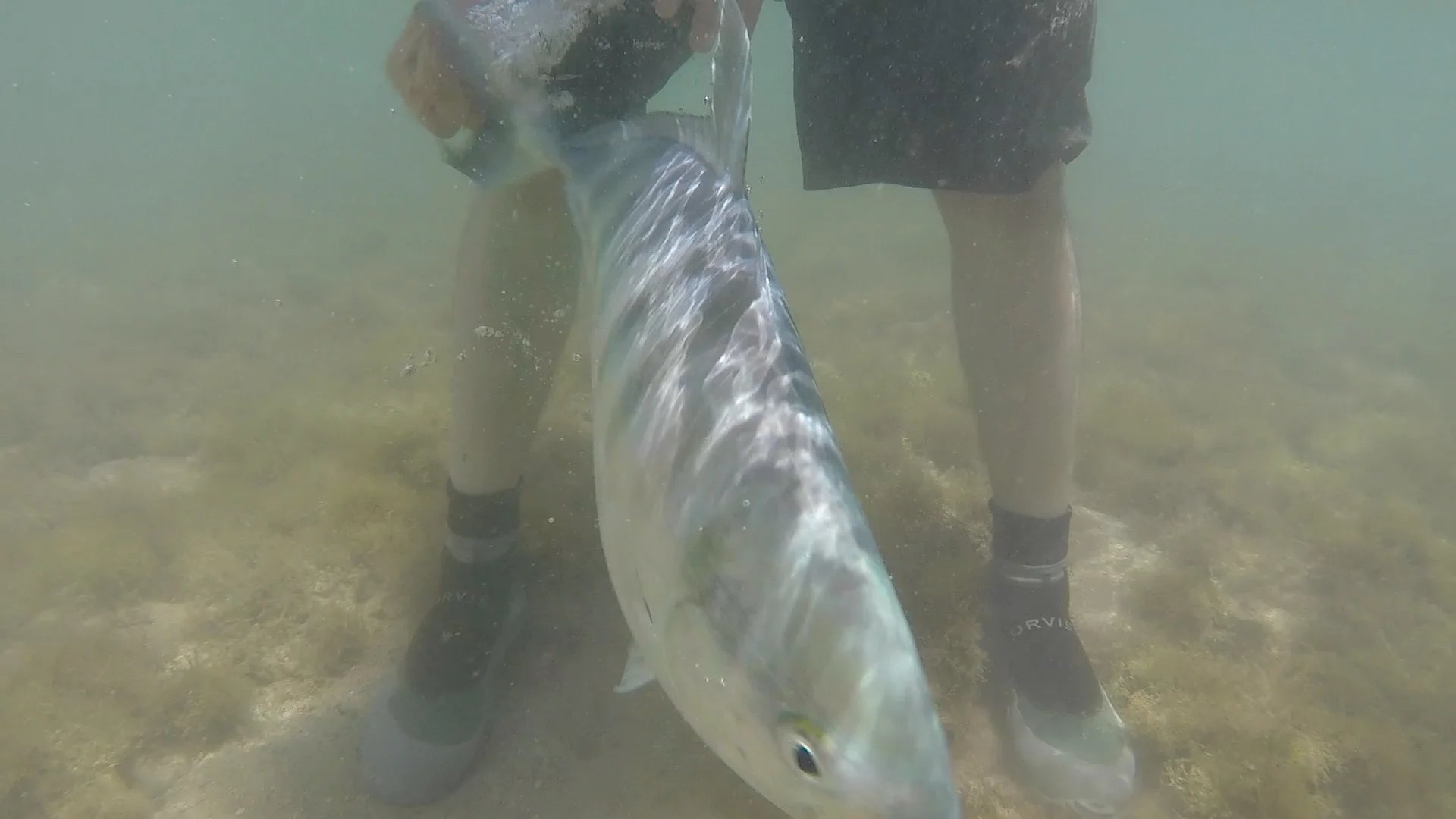
The Art of Presenting a Fly When Bonefishing
By Makani Christensen
Combined and polished manuscript — Pages 1–19
Catching bonefish on the fly is one of the most challenging and technical forms of fishing. For many fly fishermen visiting Hawaii, it can take days, weeks, or even months to hook and land their first bonefish.
When a do-it-yourself (DIY) angler spends a week on the islands chasing bonefish, only to leave empty-handed and defeated, it says something about the elusive Hawaiian bonefish. These fish are different. They are intelligent, cautious, and often unpredictable. Successfully hooking one requires more than knowing how to cast a fly rod. It requires an understanding of how bonefish behave, what they eat, how they locate food, and how they respond to a fly. That is only the tip of the iceberg. The art of presenting the fly is the cornerstone of success, and knowledge leads to success.
To understand that art, we first need to understand the fish itself.
Understanding What Bonefish Eat
Hawaiian bonefish eat almost everything. They are scavengers, hunters, and opportunistic feeders. Their diet is remarkably diverse, and the variety of bait local fishermen have used to catch them tells us a great deal about their feeding habits.
Fishermen have hooked bonefish using squid, octopus, sans turtles, crabs, live and dead Oama, sardines, halalu, shrimp, eels, akule, and other types of bait.
This wide range of food suggests that bonefish are opportunistic feeders willing to investigate almost anything that appears edible.
We have personally observed bonefish eating mantis shrimp near the surface, swimming fish, and various crustaceans along the bottom.
Fly fishermen from Hilo, Hawaii, have even opened bonefish and discovered stomachs filled with barnacles. Small black barnacles are common throughout the shallow flats where we fish, and finding them inside bonefish suggests that these fish have learned to recognize barnacles as a food source.
This is an important observation because it demonstrates how bonefish adapt their feeding behavior to their environment.
A bonefish living on a flat with abundant mantis shrimp may develop different feeding habits from one living in an area where barnacles, crabs, or other crustaceans dominate.
Understanding what bonefish eat is the first step toward understanding how to catch them.
But knowing their diet is only part of the equation.
We also need to understand how they locate, investigate, and consume their food.
How Bonefish Find Their Food
Bonefish use several senses when feeding, including smell, sight, and what I refer to as a taste or feel test.
Understanding how these senses influence feeding behavior is essential when presenting a fly.
Consider the variety of dead bait used to catch bonefish. Squid, fish, aku belly, shrimp, and other fragments of flesh release scent into the water. The fact that bonefish readily locate and consume these baits suggests that smell plays an important role in finding food.
We have observed this firsthand while bait fishing.
One technique we use to attract bonefish into an area involves throwing palu, or chum, into the water.
We cut squid into small pieces and scatter them around the area where we intend to fish. The pieces attract bonefish, sometimes encouraging them to return even after other fish have been hooked.
We often use 60-pound-test leader, a size 20 hook, and a small triangular piece of bait.
The fish can see the hook and the line, yet they still take the bait.
When bonefish are present, the scent of squid can attract them during the day or at night. Even when we cannot see the fish, we know they may eventually locate the bait.
This demonstrates the importance of smell.
However, bonefish do not rely exclusively on scent.
We have also watched them pursue swimming fish, mantis shrimp, crabs, and other living creatures. These moving targets do not necessarily produce the same strong scent as dead bait.
Instead, their movement and appearance attract attention.
This suggests that bonefish also rely heavily on sight when locating food.
The Bonefish's Taste or Feel Test
One of the most interesting feeding behaviors we have observed is what I call the taste or feel test.
Bonefish frequently investigate unfamiliar objects before committing to eating them.
Imagine a crustacean partially buried in the sand. Only a small section of its shell or a straight edge is visible above the bottom.
That slight difference in shape or texture may be enough to attract a bonefish.
The fish notices something that does not belong, approaches the object, and investigates.
If the fish cannot identify the object through sight or smell, it may suck the object into its mouth to determine whether it is edible.
Bonefish have powerful crushing structures in their throats that help them process hard-shelled prey. They can take in a crustacean, crush it, and reject unwanted material.
We see similar behavior when fishing with bait.
When a bonefish approaches and takes a piece of squid, the tip of the fishing rod may tap several times.
Sometimes those taps are followed by a strong run.
Other times, the tapping stops.
We never try to set the hook or even touch the rod until the fish starts running.
If the rod tip taps and the fish does not run, it generally suggests one of two things: either the bonefish removed the bait, or it performed a taste or feel test and rejected it.
Rather than immediately retrieving the line, we leave the bait in the water for another five minutes.
If the bait remains on the hook, the bonefish may circle back and eat it.
This behavior reveals something important about how bonefish feed.
They are curious.
They investigate unfamiliar objects, sometimes taking them into their mouths before deciding whether to swallow or reject them.
We see this behavior when bait fishing, and we see it when fly fishing.
That distinction becomes extremely important when deciding how to present a fly and when to strip-set.
A fly that remains motionless on the bottom may attract a fish, but if the fish takes it in and immediately spits it out, the angler can miss the opportunity to hook it.
The goal is not simply to get the fish to notice the fly.
The goal is to get the fish to eat it—and recognize the moment when it does.
An 18-Pound Bonefish and a Homemade Fly
A few years ago, “Luie The Fish," hooked and landed an 18-pound bonefish at Hickam Flats.
There is an area of those flats where enormous bonefish are known to feed, yet getting them to bite can be extremely difficult.
Lui spent time investigating the area and observing what the fish were eating.
He discovered sea cucumbers scattered along the bottom.
Rather than continuing to throw conventional bonefish flies, he went back to his fly-tying vise and created something different.
He took a brown-and-green curly-tail grub, cut off the tail, and attached the remaining rounded section to a hook.
A little super glue secured the material.
His fly was ready.
On his next visit to Hickam Flats, he spotted a giant bonefish moving toward a depression in the sand.
He cast his newly created fly into the depression and waited.
Rather than stripping the fly aggressively, he allowed it to roll naturally with the current.
The bonefish entered the depression.
Its tail broke the surface.
And suddenly, the fish was on.
Luie landed the giant bonefish, weighed it, and placed it in a cooler. The fish was later used for a print by Naoki, a well-known fish-print artist in Hawaii.
What makes this story interesting is not simply the size of the fish.
It is how the fish responded to the fly.
The bonefish apparently recognized the rounded object as something resembling a sea cucumber.
Its appearance attracted the fish's attention.
If the bonefish performed a taste or feel test, the soft material may have reinforced the illusion of natural food.
The fly did not need to imitate every detail of a sea cucumber.
It only needed to look convincing enough for the fish to investigate and eat.
This illustrates an important principle in fly fishing: sometimes the smallest visual detail can make the greatest difference.
Understanding the Role of Sight
We know bonefish use smell, sight, and taste or feel when feeding.
When fly fishing, however, we rely primarily on sight to attract the fish.
Unlike natural bait, most artificial flies do not release the scent of food. They also cannot reproduce every physical characteristic of the creatures they imitate.
Instead, we create a visual opportunity.
A fly becomes an object on the bottom that looks different from its surroundings.
It might resemble a crab, shrimp, small fish, or another creature.
It might have antennae, straight lines, a particular shape, or materials that move naturally in the water.
Sometimes the fly is designed to remain almost motionless.
Other times, its movement is what triggers the fish to eat.
The key is understanding what attracts the fish and how to present the fly in a way that takes advantage of that behavior.
This is where fly selection becomes important.
Different Flies Require Different Presentations
Not all bonefish flies are designed to be fished the same way.
Some are meant to rest on the bottom while their materials create the appearance of a living creature.
Others are designed to move continuously, imitating shrimp, crabs, or small fish traveling across the flats.
Understanding the difference is essential.
A fly designed to remain stationary may lose its effectiveness if stripped too aggressively.
Likewise, a fly designed to imitate a swimming creature may appear unnatural if it sits motionless on the bottom.
The way a fly is constructed should influence how it is presented.
The Kurupt Hawaiian
Elias, known as the Kurupt Hawaiian, designed a fly that can attract bonefish without requiring constant movement.
The Kurupt Hawaiian uses combinations of straight lines and materials that expand in the water, giving the appearance of a small crustacean.
When the fly settles on the bottom, its materials spread outward, creating a shape that catches the attention of passing bonefish.
We have watched fish circle this type of fly several times before eating.
Elias has described bonefish circling the fly three or four times, thumping and popping as they inspect it, then returning to eat.
Sometimes a bonefish will stare at the fly for nearly a minute before committing.
That behavior is fascinating because the fly is not necessarily moving.
Its appearance alone is enough to attract the fish.
The difficult part is recognizing the bite.
When fishing a Kurupt Hawaiian, maintaining enough tension on the line is essential.
If the bonefish takes the fly and immediately spits it out, an angler who fails to recognize the bite may miss the fish entirely.
When you feel the bite, you need to strip-set.
Even with a fly designed to attract fish while stationary, a small movement may occasionally be necessary.
If the fly is not directly in the fish's path, moving it slightly can attract attention.
Sometimes that tiny movement is all it takes.
Once the fish notices the fly, the materials and design do the rest of the work.
The Ghetto Super Fly
The Ghetto Super Fly requires a different approach.
Unlike the Kurupt Hawaiian, this fly is designed to move.
Its rectangular body resembles a mantis shrimp, and its effectiveness comes largely from how it travels through the water.
When mantis shrimp swim without being threatened, they move smoothly through the water.
That is the movement we want to imitate.
The Ghetto Super Fly should travel at a relatively constant speed along the bottom.
Rather than making aggressive, erratic strips, the angler should try to create a natural swimming motion.
When bonefish see this movement, they may believe they have the element of surprise.
The fish follows the fly, closes the distance, and sometimes darts forward to eat.
The combination of appearance and movement creates the opportunity.
Interestingly, scent does not seem necessary for this fly to work.
I have purposely covered flies with sunscreen and still managed to hook bonefish.
That experience reinforces how important visual presentation can be.
The Ghetto Super Fly does not need to smell like a mantis shrimp.
It needs to look and move convincingly enough to trigger a feeding response.
The difference between these two flies illustrates a larger lesson.
There is no single presentation that works for every fly or every bonefish.
The fly's design, the fish's behavior, and the conditions determine how it should be fished.
The Art of Getting the Fly in Front of the Fish
Once we understand how bonefish feed and how different flies are designed to work, the next challenge is presenting the fly.
This is where things become tricky.
The basic rule of thumb is to cast approximately one rod length in front of the fish and a few yards beyond its intended path.
From there, the fly can be moved into the fish's field of vision.
But that is only a starting point.
The exact placement depends on how the fish reacts, the water depth, the weight of the fly, the wind, and several other variables.
Some fish will tolerate a fly landing relatively close to them.
Others will spook from a fly landing several yards away.
The angler must learn to recognize those differences and adjust accordingly.
Fly Size and Weight
The size and weight of a fly influence how close it can land to a bonefish.
Smaller, lighter flies generally create less disturbance when they hit the water.
This allows an angler to cast closer to a fish without frightening it.
Larger, heavier flies make more noise and create a greater disturbance.
In shallow water, that impact may be enough to send a bonefish running before it ever sees the fly.
For that reason, heavier flies often require a longer lead.
The goal is to give the fly enough distance to settle before the fish reaches it.
Water Depth
Water depth also influences presentation distance.
In deeper water, an angler can often cast closer to a fish because the fly's impact at the surface is less likely to disturb it.
In shallow water, bonefish are more easily spooked.
They may also be more aware of movement above the surface.
This makes getting close to them more difficult.
The angler may need to cast farther ahead of the fish and allow it to approach the fly naturally.
There is no exact distance that works every time.
I typically begin with a cast about one rod length in front of the fish, adjusting closer or farther away depending on its reaction.
The first few presentations often reveal how much disturbance the fish will tolerate.
Why Wind Can Help Your Presentation
On a normal day in Hawaii, trade winds frequently blow between 15 and 20 miles per hour.
These winds create small waves and ripples across the surface.
Although wind makes casting more difficult, it can actually help with presentation.
Surface ripples can make bonefish easier to spot under certain lighting conditions while also masking some of the disturbance created when a fly lands.
The sound of a fly hitting the water becomes less noticeable against the constant movement of the surface.
In calm conditions, that same fly might create a distinct splash.
When there is no wind, it sometimes feels as though you need to cast a mile in front of the fish.
Every little disturbance seems more noticeable.
The fish may react to the sound or movement of the fly before it has a chance to investigate.
Personally, I would rather have some wind than no wind at all.
Wind creates casting challenges, but it also provides advantages.
Understanding how to use those advantages is part of becoming a better bonefish angler.
Getting the Fly Where It Needs to Be
Water depth, wind, and fly weight all influence how close you can cast to a bonefish.
They also influence how close you can physically approach the fish.
These are the basic factors involved in getting the fly near a bonefish without frightening it.
My favorite thing to tell clients is:
"All you have to do is get the fly in front of the fish without spooking it."
It sounds simple.
But anyone who has spent time chasing Hawaiian bonefish knows how difficult that can be.
You might make 50 casts at fish and only have one presentation where the fish actually sees the fly the way you intended.
That happens more often than most people realize.
The challenge is not simply casting accurately.
It is making the right cast, at the right distance, in the right direction, under constantly changing conditions.
Casting in Strong Winds
Some days make that challenge particularly difficult.
I remember fishing in winds blowing around 30 miles per hour, with even stronger gusts.
It was one of the windiest days I have ever experienced on the flats.
It was gnarly.
The wind was so strong that I could throw the fly line into the air and watch it carry 25 yards.
We were fishing from a boat, using a sea anchor to slow our drift across the flats.
That created several challenges at once.
I had to account for the wind, the speed of the boat, the direction of the cast, and how quickly the wind would pull the fly through the water.
Every presentation required adjustments.
Of all the fish I spotted that day, only one other fish even saw the fly.
It was not easy.
That is an extreme example, but the principle applies every time you make a cast.
The wind influences where your fly lands.
If you ignore it, the fly may land nowhere near your intended target.
Even on relatively mild Hawaiian days, casting slightly upwind of your target helps compensate for the wind pushing the line and fly.
The goal is to have the fly land where you want it—not where the wind wants to take it.
The Importance of the Double Haul
Because Hawaii regularly experiences winds of 15–25 miles per hour, learning to double haul is an important skill for fly fishermen.
The double haul allows anglers to generate greater line speed, make longer casts, and maintain better control in windy conditions.
You need to be able to cast into the wind.
Depending on the position of the sun and the amount of cloud cover, the only fish you can see may require a cast directly into the wind.
If you cannot make that cast, you may lose the opportunity.
Being able to double haul and adjust for changing wind conditions is an important part of presenting a fly.
However, casting distance is only one consideration.
Anglers also need to cast safely in different directions.
Learning to Backcast Safely
Casting in every direction is essential when fishing in the wind.
More importantly, it helps keep the fly from hitting the angler.
One of the most important rules is to keep the fly downwind of your body whenever possible.
If the fly is positioned between you and the wind, the wind can blow it directly toward you.
That can be dangerous.
A strong gust can turn an otherwise normal cast into a hook flying toward your head, shoulders, or back.
The solution is learning to use both forward casts and backcasts.
Unfortunately, many anglers avoid backcasting even when conditions make it the safer option.
I have watched experienced anglers with good double-haul techniques continue making forward casts in situations where they should be backcasting.
Even after several warnings, they sometimes continue.
Usually, after the second or third time a fly comes dangerously close to hitting them, the backcast suddenly becomes part of their arsenal.