How O’io or Bonefish Feed
/by Makani Christensen
October 24, 2026
Understanding Hawaiian Bonefish
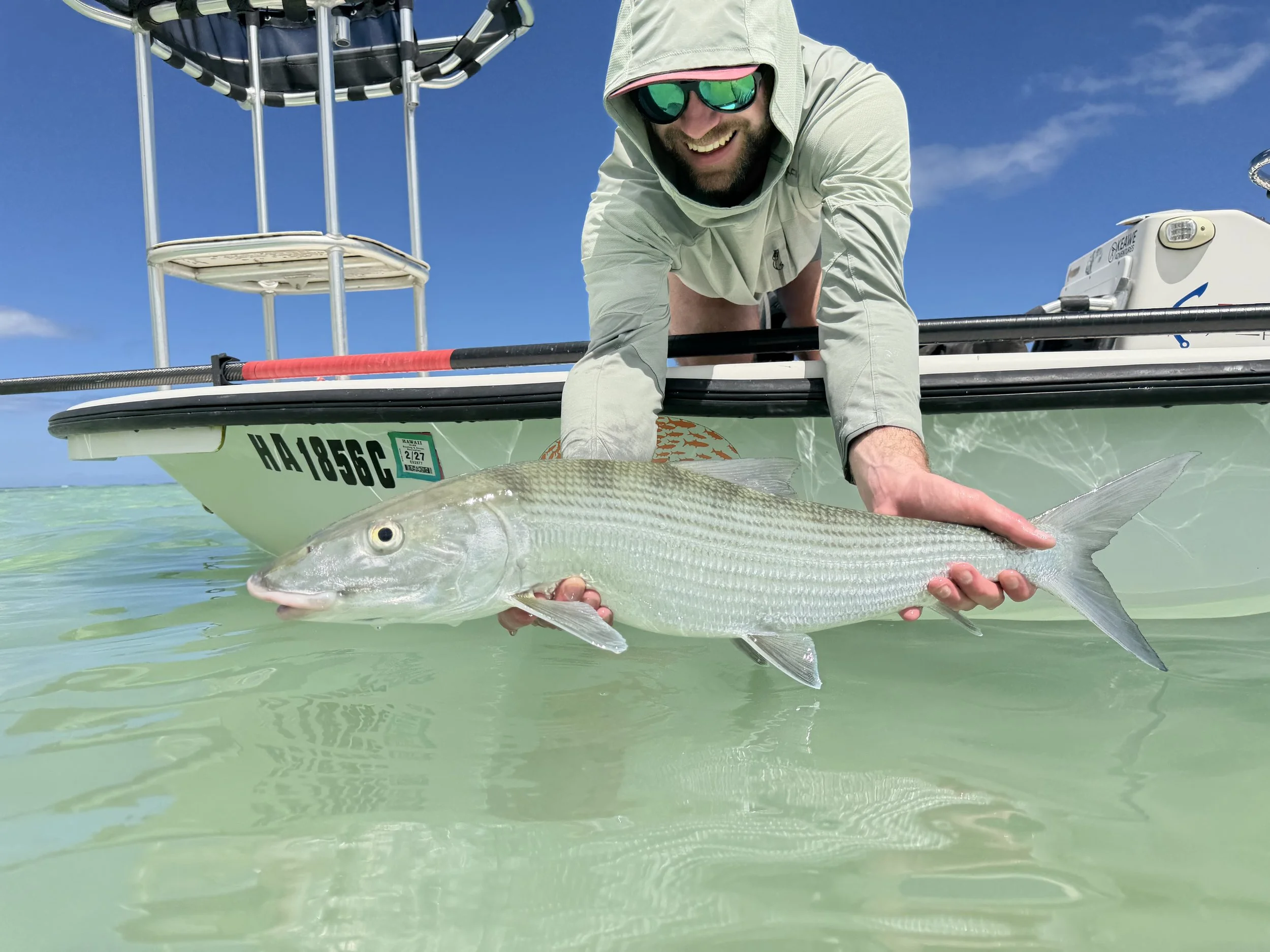
The Oʻio, or bonefish, attracts anglers from around the world to Hawaiʻi. Known for their power and long runs, Hawaiian bonefish are among the most challenging fish to catch on a fly rod.
Fly fishermen use artificial flies that imitate crustaceans and other small creatures found on the flats. Success requires accurate casting, proper presentation, and a stealthy approach.
But before you can catch a bonefish, you have to find one.
That requires understanding where they live, how they move, where they rest, and how they feed. Through years of fly fishing, commercial diving, dunking with bait, and observing bonefish throughout Hawaiʻi, I’ve developed theories about their feeding and spawning behavior. Much of what I’ve learned comes from firsthand experience, experienced fishermen, and research conducted throughout the Hawaiian Islands.
Lessons From Commercial Fishing
Before becoming a full-time fishing guide, I worked as a commercial fisherman. I was among a small group of fishermen in Hawaiʻi who used seine nets, scuba gear, and purse seines, or ʻupena, to target reef fish.
Those years taught me how different species moved around the reef, which fish shared the same habitats, and how tides and conditions affected their behavior. I also had the opportunity to fish alongside some of the greatest fishermen you’ve probably never heard of.
Their knowledge came from decades on the water. They knew where fish gathered, how they moved, and when they fed. I learned by watching, listening, and spending countless hours in the ocean.
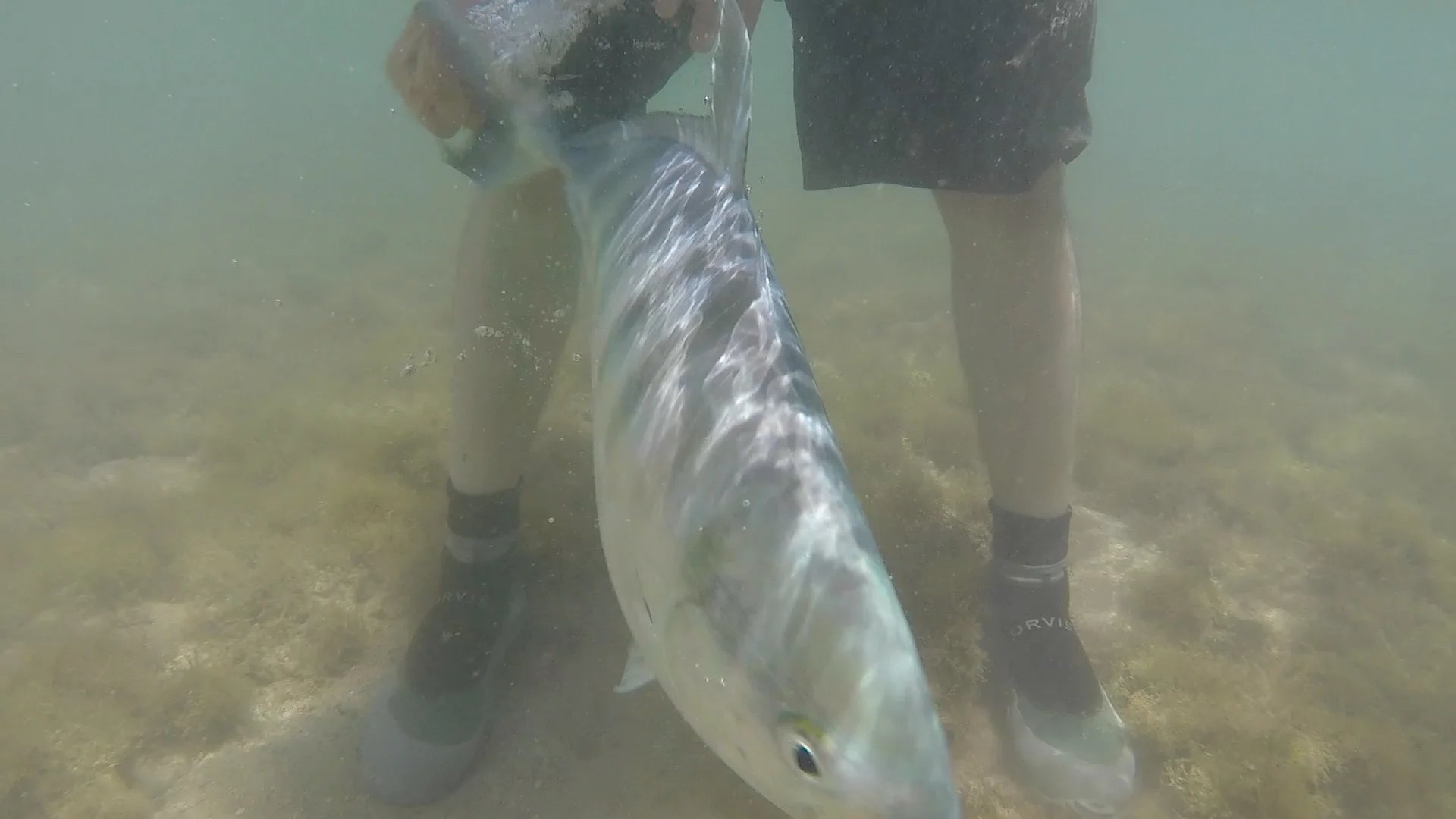
Swimming alongside fish revealed things that aren’t visible from shore: how schools form, how fish react to their surroundings, and how they move between resting and feeding areas. I’ve also learned from other commercial divers whose observations have helped me understand the elusive Oʻio.
What Dunking and Throw-Net Fishing Taught Me
Before focusing on fly fishing, I spent years dunking for Oʻio with bait. I became familiar with areas where bonefish gathered during particular tides. Some locations produced fish consistently during high tide, while others seemed empty.
That experience taught me that bonefish don’t wander randomly across the flats. Their movements follow recognizable patterns.
I also learned to throw a casting net over bonefish. Approaching them closely without frightening them requires patience, stealth, and an understanding of their behavior. Fortunately, I learned from some of the greatest throw-netters I’ve ever known. Their knowledge had been passed down through generations.
When I transitioned to fly fishing, I applied everything I’d learned. I watched where bonefish rested during low tide, how they moved onto the flats, and where they concentrated to feed. Each observation became another piece of the puzzle.
What Bonefish Research Has Revealed
Scientific research has also contributed to my understanding of Hawaiian bonefish. Two projects in particular caught my attention: a tagging study around Oʻahu and a tracking study in Hilo Bay on Hawaiʻi Island.
The Oʻahu Bonefish Tagging Project
In 2016, Carl Jellings, a commercial diving purse-seine fisherman, was contracted by the Western Pacific Regional Fishery Management Council to capture bonefish for a tagging project.
Approximately 2,000 bonefish were captured, tagged, and released. Each received a numbered green tag, and fishermen were encouraged to report tagged fish and the locations where they were caught.
According to the results I learned about, reported fish were caught within the same general areas where they had been released. None were reported from other parts of Oʻahu.
That was significant because the fish had been captured in a known resting school just outside the flats. They were not necessarily spawning fish preparing to move into deeper water; they were fish gathered in a regular resting area.
The results supported something I’d observed for years: bonefish often remain within familiar feeding and resting grounds.
There are limitations, of course. A tagged fish might have been caught elsewhere without being reported, or a tag might have broken off or gone unnoticed. The study doesn’t prove that bonefish never travel beyond their usual areas, but it does provide valuable information about their normal movements.
The Hilo Bay Tracking Project
Another project was conducted in Hilo Bay. University of Hawaiʻi researchers implanted tracking devices into bonefish to monitor their movements.
The fish remained within Hilo Bay, traveling between the Wailuku River area and Reeds Bay. This supported observations made by local fishermen: bonefish appeared to move between familiar resting and feeding locations rather than constantly traveling long distances.
These studies involved fish in their normal habitat, not necessarily fish preparing to spawn. That distinction matters because I believe bonefish behave differently during spawning season.
Understanding Resting Schools
One of the most important things I’ve learned is that bonefish don’t spend all their time feeding. They also gather in resting schools, often just outside the flats, along reef edges, or in slightly deeper water.
During low tide, bonefish may remain in these areas instead of moving onto the shallow flats. As the tide rises, portions of the school move into shallower water to feed. A large school may begin concentrated outside the reef, then spread across the flats as the water rises.
Not all resting schools are the same. Some contain hundreds or thousands of fish, while others are much smaller and occupy separate areas nearby. One school might remain outside the breaking waves while another rests inside the reef near a boat channel. When the tide rises, each may spread into a different section of the flats.
This helps explain why one area can be full of bonefish while another nearby area appears empty. It also explains why fishermen may return to a familiar location and find no fish. The bonefish may still be nearby, but their resting and feeding patterns have shifted.
If you know where fish rest, you have a better chance of predicting where they’ll feed.
Bonefish Movements in Maunalua Bay
Maunalua Bay, on Oʻahu’s southeastern shoreline, is one of the areas where I’ve spent considerable time observing bonefish. The bay stretches roughly nine miles, from the Diamond Head area toward Hanauma Bay and Portlock.
Over the years, I’ve dunked, fly fished, and thrown casting nets throughout this coastline. I’ve experienced days when there wasn’t a single bonefish around Kahala, then moved farther east and found large numbers around Kuliʻouʻou or Hawaiʻi Kai. A week later, those areas might be empty while fish had concentrated somewhere else.
Eventually, bonefish would reappear in places where I’d previously found them. I began to see a larger pattern.
My theory is that different resting schools occupy different sections of the bay and spread into nearby feeding areas according to the tides and surrounding conditions. This doesn’t mean every bonefish in Maunalua Bay belongs to one enormous school moving back and forth. I believe there are multiple schools, with some movement between them.
Understanding where those schools gather helps explain why bonefish seem plentiful in one location and absent from another.
The Triangle at Keāhi Lagoon
The Triangle at Keāhi Lagoon provides another example. During low tide, I’ve observed large schools of bonefish resting just outside the reef. As the tide rises, fish move from those resting areas and spread across the surrounding flats.
The fish around the Triangle are not necessarily the same fish found near Rat Island. Different schools may occupy separate resting areas even when those areas are close together. Some remain farther offshore, while smaller groups rest inside the reef.
Commercial divers have observed these schools for years. Combined with what I’ve seen while fly fishing, their knowledge suggests that several groups of bonefish can occupy the same general coastline while using different resting and feeding areas.
Finding bonefish often begins with locating their resting schools.
Why Bonefish Sometimes Disappear
Every experienced bonefish fisherman has encountered days when the flats seem empty. You might catch several fish in one location, return a few days later under similar conditions, and see none.
In my experience, tides, currents, food availability, seasonal changes, and the locations of resting schools all influence their movements. Fish may remain outside the reef, concentrate in another section, or feed at times when fishermen cannot see them.
I’ve caught bonefish at night under different moon conditions and during high tides when the water was too deep for practical sight fishing with a fly rod. Their feeding behavior isn’t limited to daylight hours.
The absence of visible fish doesn’t necessarily mean there are no bonefish nearby.
Bonefish Spawning Behavior
I believe bonefish move differently during spawning season than they do during normal feeding. Throughout much of the year, they appear to remain near familiar resting and feeding areas. Before spawning, however, I’ve observed large schools gathering along the outer reef.
During October and November, I’ve seen enormous numbers of similarly sized bonefish concentrating in these areas. Some schools appear to gather before moving into deeper water.
Commercial divers have also described massive schools well below the surface. One photograph I saw showed an enormous school approximately 50 feet underwater and roughly 50 yards across.
These observations suggest that bonefish may form large spawning aggregations before moving offshore.
Do Hawaiian Bonefish Spawn Twice a Year?
Based on my observations and accounts from other fishermen, I suspect Hawaiian bonefish may have more than one spawning period each year.
I’ve seen signs of fish gathering during the fall and winter, particularly from October through February, and I’ve encountered fish during summer that appeared to be preparing to spawn. This makes me wonder whether different schools spawn at different times.
That remains a theory. More research is needed to determine when Hawaiian bonefish spawn, whether individual fish spawn more than once a year, and how spawning patterns vary by location.
What I do know is that I’ve witnessed dramatic changes in the number and size of bonefish gathering along the reef during certain times of year. October and November have been particularly productive months for me, with large bonefish often plentiful.
How Far Do Bonefish Travel to Spawn?
If bonefish generally remain near their feeding grounds, what happens when they spawn? How far offshore do they travel, and do they return to the same resting schools afterward?
Bonefish have been caught in surprisingly deep water around Hawaiʻi. One was caught by bottom fishermen off the Kona Coast in approximately 180 feet of water. Another was a 28-pound bonefish caught near Bamboo Ridge on Oʻahu’s southeastern shoreline.
That fish was caught by a fisherman targeting other species. Nearby fishermen then changed their rigs to target bonefish, and several more were caught, suggesting that a school had moved through the area.
I’ve also heard reports of schools several miles offshore. These accounts raise questions about how far bonefish travel during spawning season. They may move much farther than fish tracked in their normal feeding habitats.
Without additional research, however, we cannot say exactly how far they travel or whether they consistently return to the same areas.
Hawaiʻi’s Giant Bonefish
Hawaiʻi is known for exceptionally large bonefish. It’s not uncommon to hear stories of fish weighing 15 pounds or more.
In 2014, two 17-pound bonefish were reportedly caught, one on Hawaiʻi Island and another on Maui. In 2026, an 18-pound bonefish was reportedly speared off Oʻahu. Other reported catches include a 23-pound fish off Kaʻaʻawa, an 18-pound fish landed on the Hickam Flats in 2009, and the 28-pound bonefish caught near Bamboo Ridge.
These are only some of the catches I’ve heard about. Many giant bonefish were never officially weighed or documented.
The presence of these exceptionally large fish makes their movements and spawning behavior even more interesting.
Why More Research Matters
Despite what we’ve learned, many questions remain:
Where do bonefish spawn? How far do they travel? Do different schools spawn at different times? How often do they return to the same feeding and resting areas?
Through years of observation, I’ve developed theories about these questions, but I continue learning every year. Additional research would be valuable, especially studies of spawning behavior, offshore movements, and the relationship between resting schools and feeding areas.
Research should also be conducted carefully. We shouldn’t assume bonefish populations are in trouble simply because concerns have been raised, nor should healthy schools in a few areas be taken as proof that all populations are thriving.
Good research should distinguish between those possibilities. Before imposing additional regulations, we should understand the fish, the evidence, and the effects on people who depend on these resources.
Conservation and traditional fishing practices don’t have to oppose each other. Both benefit from accurate information and a better understanding of the ocean.
Knowledge Is Power
When it comes to catching bonefish, knowledge is power. Understanding where they rest, how they move with the tides, and where they feed gives you a tremendous advantage.
You can read books, watch videos, and study techniques, but nothing replaces time on the water. Pay attention to the tides and currents. Watch where fish gather and how they respond to changing conditions. Remember where you find resting schools and how fish spread across the flats as the tide rises.
Eventually, patterns emerge. What once seemed random begins to make sense, and you start finding bonefish more consistently.
Preserving Hawaiʻi’s Fishing Traditions
As long as I’m alive, bonefish will remain part of our local menu.
We are ocean people, and fishing has been part of our way of life for generations. Our ancestors passed down knowledge through hunting, fishing, gathering, and teaching their families how to live from the ocean. Not so long ago, catching fish could mean the difference between eating and going hungry.
Today, we have Costco, grocery stores, and countless food choices. But convenience shouldn’t replace tradition. The opportunity to fish, gather food, and pass that knowledge to our families helps keep our culture alive.
For me, bonefish represent more than an incredible sport fish. They’re part of Hawaiʻi’s fishing heritage. Whether you catch them on a fly rod, with a throw net, or with bait, understanding these fish makes you a better fisherman.
The more we understand the ocean, the better we become at fishing it—and the better prepared we are to pass that knowledge on to the next generation.